What to Put on an Invoice: Checklist & Example
An invoice should identify who is charging whom, what was supplied, how the amount was calculated, when it is due, and how to pay it. In practice, that means a clear invoice label, unique number, supplier and customer details, dates, itemized work, named currency, subtotal, applicable tax, total, payment term and payment instructions.
That is the practical core—not a universal legal checklist. Tax registration, seller location, customer location, supply type and invoice value can add or change required fields. This guide separates the fields that make almost any invoice usable from rules that need local verification.
What to put on an invoice: the short checklist
- Invoice label—or tax/VAT invoice wording only when appropriate
- A unique invoice number
- Invoice date and any relevant supply or service date
- An exact payment due date
- Supplier legal or trading name, address and contact details
- Customer legal name, billing address and accounts-payable contact
- Applicable business, VAT, GST or sales-tax registration details
- PO, contract, project or customer reference when required
- Specific line items with quantity or hours, rate and line amount
- Named currency, subtotal, discounts and total
- Applicable tax rate, taxable amount and tax total
- Agreed payment terms
- Payment method and invoice reference
- A final arithmetic, identity and payment-destination check
Download the same review list as
CSV or
JSON. The JSON includes our method,
scope, official regional sources and a note for every field. Both files are
versioned 2026-08-13 so another person—or a software test—can review exactly
what this page means by a complete invoice.
What should an invoice look like?
A good invoice does not need elaborate decoration. It needs a strong reading order: identity at the top, both parties and dates next, itemized charges in the middle, a prominent total, then the agreed payment details. A logo is optional; clarity is not.
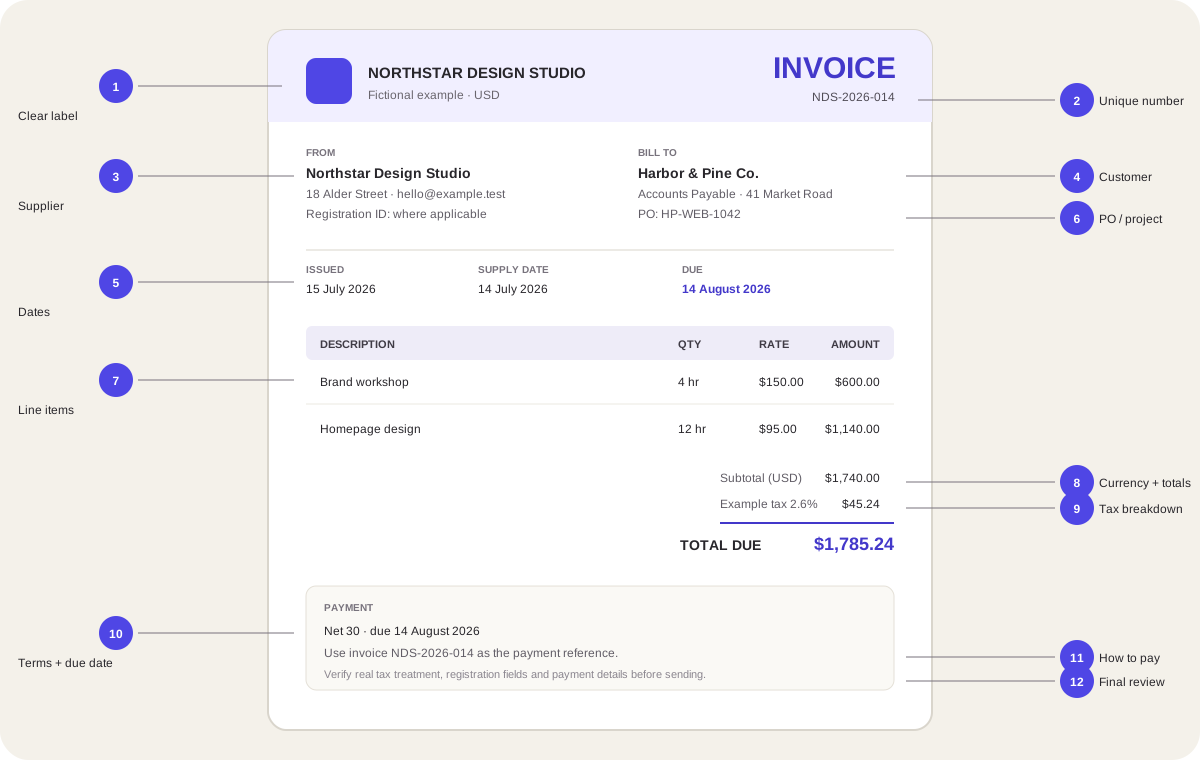
The illustration uses five visual zones:
- Identity: invoice label, unique number and supplier brand.
- Parties and references: supplier, customer and PO or project reference.
- Dates: issue date, supply date when relevant, and exact due date.
- Charges: descriptions, quantities, rates, tax and a visually dominant total.
- Payment: agreed term, method, reference and final review reminder.
This layout is a usability pattern, not a prescribed government form. A country, customer portal or industry may require different wording, structured e-invoicing, extra identifiers or a particular submission route.
The 14 invoice details, field by field
1. Correct document label
Use Invoice for a payment request. Do not label a quote, proforma invoice or receipt as an invoice merely because the documents share similar fields. Use Tax Invoice or VAT Invoice only when your registration and local rules support that wording. The Australian Taxation Office, for example, says a business that is not GST-registered should not use the words “tax invoice.”
2. Unique invoice number
Use a number that appears only once in your records, such as
NDS-2026-014. A stable pattern helps both parties find the document, match a
payment and reference a correction. Avoid resetting to Invoice 1 for every
customer if that creates duplicates.
Some systems are more specific. UK guidance calls for a unique identification number; EU full VAT invoices use a unique sequential number; India’s GST rules describe a serial number unique for the financial year. Choose the pattern only after checking the rule that actually applies.
3. Invoice date and supply date
The invoice date tells the recipient when the document was issued. A separate supply date or service period shows when goods were delivered or work was performed. Do not silently substitute one for the other when local tax timing depends on the distinction.
For recurring services, a description such as Website maintenance — July 2026 can connect the charge to its period even when each task is not listed.
4. Exact due date
Print the calendar date even when the agreement uses shorthand:
Net 30 — payment due August 14, 2026.
That is clearer than Net 30 alone because contracts can define different
starting events. Use the invoice due date calculator
when you need to compare calendar days, weekdays and an explicit weekend rule.
5. Supplier details
Show the correct legal name or registered trading name, a usable address and a contact method. Depending on structure and jurisdiction, a company number, registered office, ABN, GSTIN, VAT number or other identifier may also be required.
Keep personal identifiers out unless they are genuinely required. An invoice may be forwarded, retained for years or entered into another organization’s accounting system.
6. Customer and billing details
Use the name that matches the agreement or purchase order—not just the first person who emailed you. Larger customers may need a legal entity, billing address, department, accounts-payable email and named requester.
Buyer details can also be threshold-dependent. Australian tax invoices for sales of AU$1,000 or more require buyer identity or ABN; Canadian GST/HST supporting information expands at higher transaction values. Verify current thresholds rather than copying an old template.
7. Tax and registration identifiers
Use dedicated fields for applicable VAT, GST, HST, ABN, GSTIN or other business identifiers. This makes them easy to check and avoids burying them inside an address. Never invent an identifier or treat the presence of a tax-rate box as proof that you are registered to charge that tax.
8. PO, contract or project reference
A purchase-order number may not be a universal legal requirement, but it is often the difference between an invoice being processed and rejected. Copy it exactly. Where there is no PO, a contract number, project name, job address or customer reference can provide the same operational link.
9. Itemized goods or services
Each line should let the customer verify the charge. Include:
- a specific description;
- quantity, hours or units where relevant;
- unit rate or price;
- line amount; and
- any required item, service, HSN/SAC or industry code.
Homepage design — 12 hours × $95 is easier to approve than Design work.
Descriptions should agree with the quote, statement of work, delivery evidence
and pricing basis.
10. Currency, subtotal, discounts and total
Name the currency: USD, CAD and AUD all use a dollar symbol. Present the
math in a consistent order:
- line amounts;
- subtotal;
- agreed discount;
- taxable amount;
- tax by applicable rate; and
- final amount due.
The final total should be the most prominent number in this section. Round consistently and check whether the applicable tax system specifies how rounding is handled.
11. Tax breakdown
Show the rate, taxable amount and tax total when required. If supplies have different treatments, identify which lines are taxable, exempt, zero-rated or otherwise treated under the rules that apply.
Do not copy the 2.6% rate from our illustration. It is deliberately fictional.
Registration, exemptions, customer type, product, destination and
place-of-supply rules can all change the correct result.
12. Agreed payment terms
State the term already agreed in the contract, accepted quote or PO. Deposits, milestones, early-payment discounts, late fees and interest need more context than a generic sentence. An invoice should record the arrangement rather than attempt to introduce a new charge after the work.
Our payment-terms guide explains Due on
Receipt, Net 7 through Net 90, EOM and 2/10 Net 30 without presenting one term
as universally best.
13. Payment instructions and reference
Tell the customer how to pay and which reference to use. Depending on the agreed method, that might mean a payment link, remittance email, cheque payee or bank-transfer reference.
Treat an unexpected bank-account change as a fraud risk. Both parties should confirm it through a known, independent channel—not only through the changed invoice or the email carrying it.
14. Final review and supporting records
Before sending, verify names, dates, PO, currency, line calculations, tax, total, due date and payment destination against the underlying records. Open the final PDF and make sure nothing is clipped. Keep it with the agreement, accepted quote, PO, delivery evidence, correction and payment record.
Invoice requirements by country or region
There is no worldwide invoice law. This matrix summarizes what each linked authority illustrates; it does not transplant one region’s rules into another.
| Region | What the official source establishes | What to verify |
|---|---|---|
| United States | IRS Publication 583 treats invoices as supporting business records and emphasizes orderly records supporting income and expenses. It is not a universal federal invoice-layout rule. | State, local, sales-tax, trade-name, customer and industry requirements. |
| United Kingdom | GOV.UK lists a unique number, supplier and customer details, descriptions, supply and invoice dates, amounts, applicable VAT and total; business structure and VAT status add fields. | VAT-invoice rules, sole-trader or limited-company details, and the actual transaction. |
| European Union | The European Commission VAT guide distinguishes full and simplified VAT invoices and notes Member State rules and special cases. | Seller Member State, B2B/B2C status, cross-border treatment, reverse charge and national rules. |
| Canada | The CRA GST/HST guide uses transaction-value bands for information supporting input tax credits and explains GST/HST disclosure. | Current value band, supplier registration, buyer details, province and tax treatment. |
| Australia | ATO tax-invoice guidance separates standard invoices from GST tax invoices and adds buyer identity or ABN for sales of AU$1,000 or more. | GST registration, taxable-sale status, current threshold and mixed-tax treatment. |
| India | CBIC invoice rules list GST tax-invoice particulars including supplier GSTIN, financial-year-unique serial number, date, recipient information, HSN/SAC, description, quantity and values. | Current Rule 46 requirements, place of supply, reverse charge, e-invoicing and transaction-specific fields. |
| New Zealand | Inland Revenue explains that “taxable supply information” replaced the former tax-invoice requirement from April 1, 2023 while allowing existing invoice documents to carry the information. | GST registration, supply value band and current taxable-supply information. |
These links were reviewed on August 13, 2026. Government requirements can change. Check the current page and obtain qualified advice where an error could affect tax, a customer claim or a legal dispute.
Worked invoice example with the arithmetic shown
The anatomy illustration uses a fictional design studio billing in USD:
| Line | Calculation | Amount |
|---|---|---|
| Brand workshop | 4 × $150.00 | $600.00 |
| Homepage design | 12 × $95.00 | $1,140.00 |
| Subtotal | $600.00 + $1,140.00 | $1,740.00 |
| Fictional example tax | $1,740.00 × 2.6% | $45.24 |
| Total due | $1,740.00 + $45.24 | $1,785.24 |
The example also prints USD, the invoice number, issue and supply dates, an
exact Net 30 due date, PO reference and payment reference. It deliberately does
not pretend that the tax rate, registration line or address is valid for a real
transaction.
Common invoice mistakes—and the clearer alternative
| Weak invoice text | Why it causes trouble | Clearer version |
|---|---|---|
Services rendered |
The approver cannot match it to scope or delivery. | Homepage design — 12 hours × $95 |
$1,785.24 |
The currency is ambiguous internationally. | Total due: USD 1,785.24 |
Net 30 |
The starting date may be disputed. | Net 30 — due August 14, 2026 |
Tax: 10% copied from a template |
The seller may not be registered or the supply may have another treatment. | Use the verified rate, basis, registration and required wording. |
| A customer contact’s nickname | It may not match the contracting or paying entity. | Use the legal customer and correct billing department. |
| New bank details only in an email | Payment-diversion fraud can look like a routine update. | Confirm through a previously trusted channel. |
Build the invoice without uploading the contents
The free invoice generator implements this reading order with worldwide currencies, Letter or A4 output, line-item math, optional tax IDs, PO and supply-date fields, synchronized payment terms and an exact due date. It produces selectable-text PDF locally in your browser. DraftFort does not receive or store the invoice contents.
The generator can structure and calculate the document. It cannot determine your registration status, tax treatment, contract terms or local compliance. Those decisions must come from the real transaction and applicable authority.
How this guide was researched
We started with DraftFort’s actual Search Console language—especially “what to put on an invoice,” “invoice details” and “what should an invoice look like.” We then separated user-interface advice from legal and tax claims, checked the seven government sources linked above, built one fictional arithmetic example, and published the underlying checklist in both human- and machine-readable formats.
This is a field-review framework, not a claim that every field is legally required everywhere. If you cite or reuse the data, preserve its version, source links and scope note so readers can see those boundaries.